
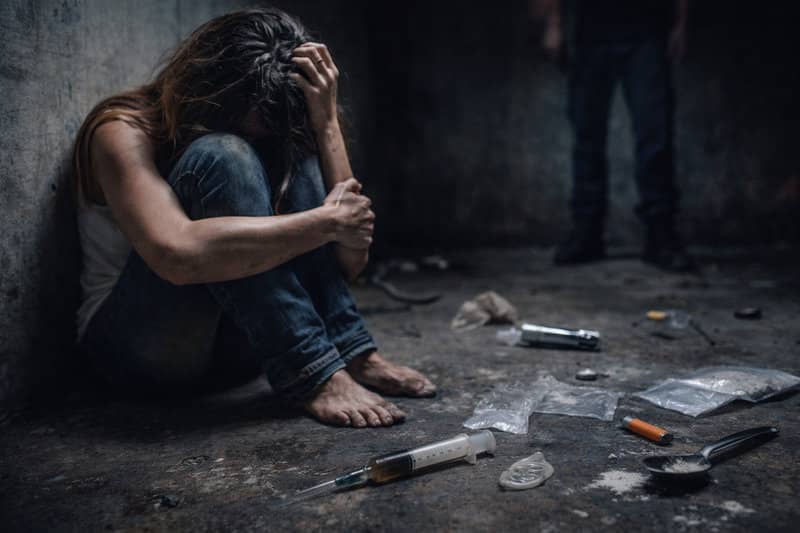
Drug addiction and sex trafficking are two of the most devastating crises facing communities across the United States. On the surface, they may appear to be separate problems: one a public health emergency rooted in brain chemistry and trauma, the other a crime perpetrated by predators. But in practice, they are deeply intertwined. Understanding their connection is essential to identifying victims. And as we’ve learned at our women’s recovery program for trafficking survivors, it’s also essential for delivering effective treatment and helping survivors find a genuine path to freedom.
The Scale of the Problem
Human trafficking is far more pervasive than most people realize. According to the U.S. Department of State’s 2024 Trafficking in Persons Report,1 an estimated 27 million people worldwide are currently being exploited through force, fraud, or coercion for labor or commercial sex. In the United States alone, the National Human Trafficking Hotline has identified more than 112,000 cases of trafficking involving over 218,000 victims.2
The most common form of human trafficking globally is sexual exploitation. And within sex trafficking cases in the U.S., drugs are not a peripheral detail; they are often a central mechanism of control. According to the FBI’s special report on Human Trafficking and Drug Offenses, drug violations are among the most common additional offenses associated with trafficking incidents in this country, and as trafficking reports increase, connected drug offenses increase in parallel.
How Traffickers Use Drugs as a Weapon
Traffickers are skilled, calculating predators who study and exploit vulnerability. Drug addiction, whether pre-existing or deliberately created, is one of the most reliable tools in their arsenal.
Traffickers use drugs to control victims in several overlapping ways. First, they target people already in active addiction: individuals who may be homeless, estranged from family, and financially desperate. Traffickers offer drugs, housing, or affection, then use the deepening dependency to trap them. Some even target those who are fresh out of addiction treatment facilities and still trying to navigate the transition between immersive treatment and a return to real life.
Second, traffickers deliberately create addiction in victims with no prior substance use history. They provide drugs freely at first, framing it as a gift or a way to bond, until physical dependency takes hold. Once the victim’s body requires the drug to function, the trafficker becomes the sole supplier. Courts have recognized this explicitly: in multiple successfully prosecuted trafficking cases, judges found that the threat of withdrawal sickness constitutes a form of psychological harm sufficient to meet the legal definition of coercion under federal trafficking statutes.3
Finally, traffickers use drugs to maintain ongoing compliance: providing substances as rewards, administering them to reduce resistance, or keeping victims in a near-constant state of intoxication to diminish their ability to plan an escape or seek help.
The Numbers Tell a Stark Story
The data on substance use among sex trafficking survivors is striking. A survey of survivors in the United States found that 84 percent used substances during their trafficking exploitation, with 25 percent reporting heroin use specifically.4 Research into child survivors in California found that a significant number of them were using substances at the time they exited trafficking. The 2017 Federal Human Trafficking Report found that traffickers exploited victims’ substance use issues in one-third of active criminal sex trafficking cases, more than three times as often as they exploited romantic relationships.4
Drugs as Coping, Not Just Coercion
It would be a mistake to frame addiction in this context as only something done to victims. For many survivors, substance use also becomes a self-directed coping mechanism, a way of surviving the unsurvivable.
Survivors are routinely subjected to physical violence, sexual assault, psychological abuse, and isolation from support systems. Rates of PTSD among trafficking survivors rival those seen in combat veterans.5 In the absence of therapy or safe housing, substances can become the only available means of numbing the pain and getting through another day.
This creates a cruel dynamic: the same addiction used to trap a victim may later become the tool through which they try to survive the trauma of having been trafficked. Substance use that begins under coercion can persist long after a person has physically exited a trafficking situation because the underlying trauma remains unaddressed.
The Barriers Addiction Creates for Survivors
For survivors trying to access help, addiction creates strong barriers. Research from RAND Corporation6 has documented that sex trafficking victims with substance use disorders are frequently perceived as hostile and uncooperative by first responders. But this is usually because their behavior is shaped by active addiction and deep trauma, not willful obstruction. This stigma causes healthcare providers and social workers to miss the signs of trafficking entirely, seeing only the symptoms of substance use.
Addiction also creates a powerful pull back toward trafficking. Without immediate access to medication-assisted treatment, a survivor may return to their trafficker simply to avoid withdrawal, not out of choice, but because their body demands it. The fear of withdrawal is a physiological reality that traffickers understand and deliberately exploit, making relapse and re-trafficking tragically common.
Treatment That Understands the Connection
Effective treatment for survivors must address addiction and trauma simultaneously. Trauma-informed, survivor-centered care means treatment delivered by professionals who understand trafficking dynamics, who don’t interpret survival behaviors as obstruction, and who create environments where survivors feel safe enough to begin healing. It means integrated dual-diagnosis treatment that addresses both addiction and co-occurring mental health conditions.
Residential drug treatment programs are one of the most effective settings for this dual recovery. Inpatient care provides 24-hour medical support to manage withdrawal safely, removing the physiological hold traffickers rely on. At the same time, they offer immersive therapeutic programming that addresses trauma and builds coping skills.
Critically, a residential setting removes the survivor from the environments and relationships associated with their trafficking and drug use, creating physical and psychological distance from the world their trafficker controlled. The wraparound services offered through quality residential programs, such as case management, legal advocacy, housing support, and peer mentorship, are not supplementary. They are essential.
A Crisis That Demands Compassion and Action
Sex trafficking and drug addiction are not separate crises that occasionally overlap. They are deeply linked systems of exploitation and suffering, each reinforcing the other. When we treat a person’s addiction without asking how they came to be addicted, we miss the trafficking. When we try to help a trafficking survivor without treating their addiction, we leave the door open for traffickers who know exactly how to exploit that dependency.
Survivors deserve care that sees all of who they are and all of what was done to them. They need treatment that meets every dimension of that reality with skill, compassion, and evidence-based practice.
If you have been trafficked and need help overcoming addiction, contact our women’s inpatient rehab in Idaho. We will meet you with empathy and help you find a path forward.
If you or someone you know may be a victim of sex trafficking, contact the National Human Trafficking Hotline at 1-888-373-7888 or text “HELP” to 233733.
1https://www.state.gov/reports/2024-trafficking-in-persons-report/
2https://humantraffickinghotline.org/en/statistics#:~:text=Signals,were%20identified%20in%20these%20cases.
3https://2017-2021.state.gov/the-intersection-of-human-trafficking-and-addiction/#:~:text=Within%20the%20past%20several%20years,fabrication%2C%20and%20other%20dangerous%20work.
4https://traffickinginstitute.org/addicted-to-you-drug-addiction-as-a-means-of-coercion/#:~:text=These%20experiences%20demonstrate%20two%20ways,Supreme%20Court%20Justice%20William%20J.
5https://www.sciencedirect.com/science/article/pii/S0213616322000076
6https://www.rand.org/pubs/research_reports/RRA108-13.html