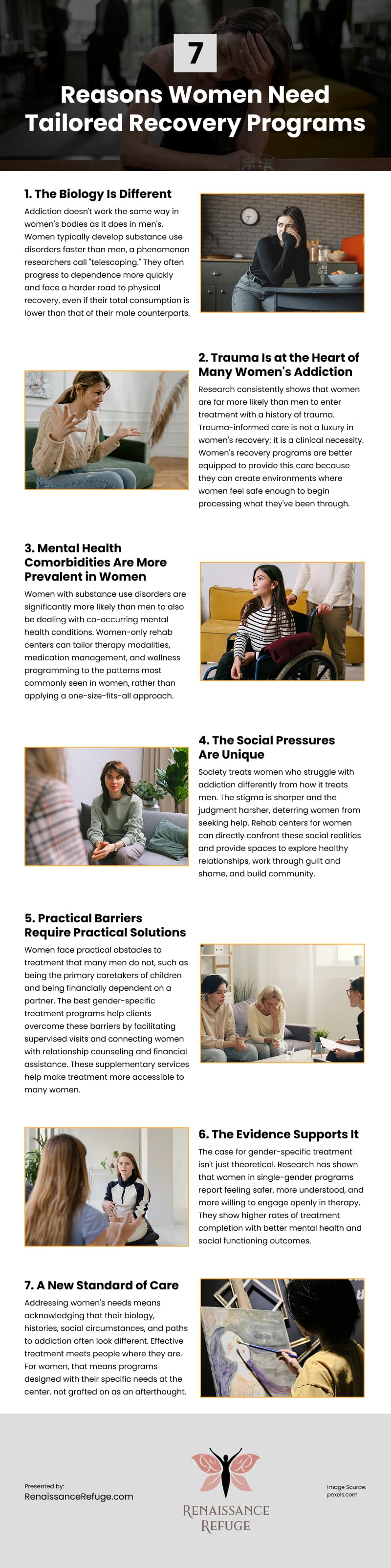
For decades, addiction treatment was designed almost exclusively with men in mind. The research was conducted on men, the programs were built around men's experiences, and the outcomes were measured against male benchmarks. Women who sought help were expected to fit into a framework that was never built for them.
Today, we know better, and the evidence1 is clear that gender-specific rehabilitation programs don't just help women more; for many, they may be the difference between recovery and relapse.
The Biology Is Different
Addiction doesn't work the same way in women's bodies as it does in men's. Women typically develop substance use disorders faster than men, a phenomenon researchers call "telescoping." A woman who begins drinking heavily or using drugs will often progress to dependence more quickly, experience more severe health consequences sooner, and face a harder road to physical recovery, even if her total consumption is lower than a male counterpart's.
The physiological reasons are well documented. Women generally have lower body water content and different metabolic rates, meaning alcohol and drugs reach higher concentrations in the bloodstream faster.
Hormonal fluctuations across the lifespan interact with substance use in complex ways, affecting everything from cravings to withdrawal symptoms. Women are also more susceptible to alcohol-related liver damage, heart disease, and brain deterioration at lower consumption levels than men.
A treatment program that doesn't account for these biological realities is, at best, incomplete. Gender-specific programs build medical and clinical care around the specific physiology of women's bodies, improving outcomes at every stage from detox through long-term maintenance.
Trauma Is at the Heart of Many Women's Addiction
Research consistently shows that women are far more likely than men to enter treatment with a history of trauma. Studies suggest that anywhere from 55 to 99 %2 of women in substance abuse treatment report histories of physical or sexual trauma. For many, substance use began as a way to cope with that trauma.
Treating the addiction without treating the underlying trauma is like patching a wound without treating its cause. Trauma-informed care is not a luxury in women's recovery; it is a clinical necessity. Women's recovery programs are better equipped to provide this care because they can create environments where women feel safe enough to begin processing what they've been through. In this safe space, they feel freer to open up to therapists who have had similar experiences.
Co-ed programs can make this far more difficult. For a woman who has experienced abuse at the hands of men, sharing in a group therapy session with male strangers can feel threatening rather than therapeutic. The very setting can trigger the hypervigilance and emotional shutdown that trauma produces, making it harder to engage honestly in treatment.
Mental Health Comorbidities Are More Prevalent in Women
Women with substance use disorders are significantly more likely than men to also be dealing with co-occurring mental health conditions, particularly depression, anxiety disorders, eating disorders, and post-traumatic stress disorder. These aren't separate problems that can be set aside until the addiction is "handled." They are deeply intertwined with it. Depression can fuel drinking; anxiety can drive opioid misuse; disordered eating and substance use often feed each other in complex cycles.
Women-only rehab centers are better positioned to address these additional diagnoses in an integrated way. They can tailor therapy modalities, medication management, and wellness programming to the patterns most commonly seen in women, rather than applying a one-size-fits-all approach that was calibrated to a different demographic.
The Social Pressures Are Unique
Society treats women who struggle with addiction differently from how it treats men. The stigma is sharper, the judgment harsher, and the consequences often more severe. A woman who is a mother may fear that seeking help for addiction will result in losing custody of her children. A woman in a professional role may worry about the damage to her reputation. These fears keep women from getting help, and they can become powerful triggers for relapse.
Women are more likely to use substances within the context of a relationship. They may be introduced to drugs by a romantic partner or use substances together as part of the relationship dynamic. Addressing addiction without addressing those relational patterns leaves a major vulnerability intact.
Rehab centers for women can directly confront these social realities. They provide spaces to explore what healthy relationships look like, to work through the guilt and shame that women disproportionately carry, and to build community with others who understand those pressures firsthand.
Practical Barriers Require Practical Solutions
Women face practical obstacles to treatment that many men do not. They are more likely to be the primary caretakers of children, which means that entering a residential program requires solving an immediate childcare crisis. They are more likely to be financially dependent on a partner, which can mean having no resources of their own to pay for treatment. Many programs have historically made no accommodation for these realities.
The best gender-specific treatment programs help clients overcome these barriers. While most programs won't allow children on-site, they can facilitate supervised visits. They can also connect women with relationship counseling, financial assistance for school, job training, and financial literacy education. These supplementary services help make treatment more accessible to many women.
The Evidence Supports It
The case for gender-specific treatment isn't just theoretical. Research has shown that women in single-gender programs report feeling safer, more understood, and more willing to engage openly in therapy. They show higher rates of treatment completion with better mental health and social functioning outcomes.
The therapeutic environment matters. When women feel heard, believed, and understood by the people around them, they are better able to do the hard work of recovery.
A New Standard of Care
Addressing women's needs means acknowledging that their biology, histories, social circumstances, and paths to addiction often look different. Effective treatment meets people where they are. For women, that means programs designed with their specific needs at the center, not grafted on as an afterthought.
Take the first step toward healing and contact our women's recovery program in Idaho today.
2https://pmc.ncbi.nlm.nih.gov/articles/PMC3860828/
Video
Infographic
Addiction treatment has long relied on male‑centered models, yet growing evidence shows that women benefit significantly from programs designed around their unique biological, psychological, and social needs. This infographic highlights why women require tailored recovery approaches.